230 Micro Pump™ is not stroking.
- General Operation: The Unist 230 Micro Pump™ is a pneumatically operated positive displacement pump. It requires an adequate air pressure source to properly operate the pump. Pumps can be driven with a valve mounted to the manifold for each pump, for a group of pumps, or remote valve. Systems can also come equipped with a pulse generator (PG) which cycles the pump at an adjustable rate when air pressure is applied to the system, or a Pulse R that controls the cycle rate electronically when air pressure and 24VDC are applied to the system.
- Air Pressure: The pumps need a minimum of 80 psi to operate properly. Less than 80 psi supply pressure to the pumps may affect cycle rate (pulse generator driven pumps), the pump’s ability to stroke, and/or how quickly the pump can be cycled. Reduced air pressure can also reduce air output at the nozzle tip.
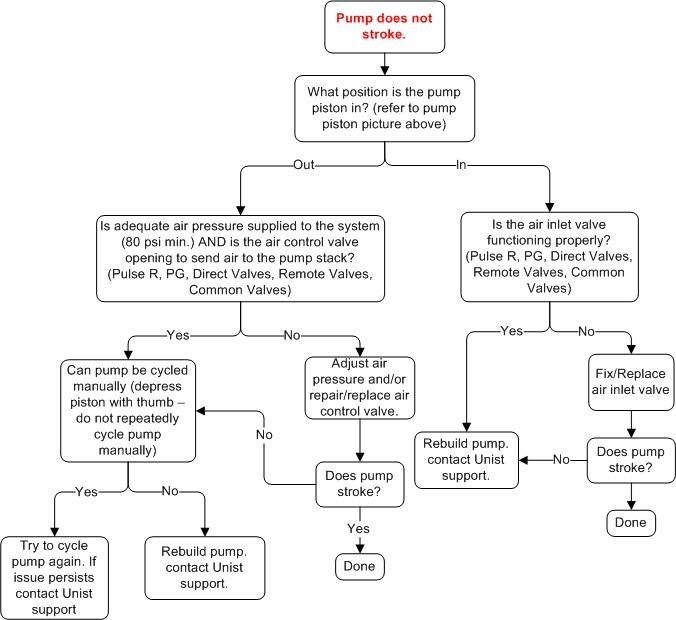
A pump that is stuck and/or not stroking can be caused by an inadequate air signal to the pump or an internal problem with the pump. If the pump piston is not moving it is helpful to distinguish if the piston is stopped in the in or out position. The pumps below are shown in the out position. When the pump receives the proper air signal the piston will stroke and will move into the adjustment knob or air cap. When the air signal is removed the piston will retract.
A pump piston that is stuck out is most likely an air signal issue (low pressure, pulse generator, valve) if it can be manually cycled. If the air signal is verified as good then there may be a problem with the seal (U-cup) on the piston. U-cup failure is relatively rare. A pump piston stuck in could be the metering pin itself stuck in the O-rings in the upper insert in the pump. Older pumps that have been sitting dormant with certain fluids can experience a momentary stuck piston that may be rectified by manually pressing on the piston.

Follow the troubleshooting flow chart below to determine the root cause.